Struggling to finish ALEKS? Wondering how to finish ALEKS topics fast so you can be done with it? Then this blog is for you. ALEKS is one of the premium learning management systems; however, there’s a significant issue with it.
Most students complain about dealing with a ridiculous number of ALEKS problems every week, which is a significant issue for busy professionals and students with a time crunch. However, with a problem comes a solution. Today, we will discuss 20 ways to master ALEKS!
Let’s get started!
ALEKS is based on a continuous cycle of Assess → Learn → Reassess theory. Since ALEKS is an adaptive platform, it ensures that the learning process is highly personalized and that mastery is genuine and retained over time. Let’s understand in detail:
The Initial Knowledge Check (Assessment)
Diagnosis of Knowledge: When you first start an ALEKS course, you take a non-multiple-choice, adaptive assessment. This check is one of the ALEKS efficient methods, where you get only about 20-30 questions. This pinpoints to what you know, what you don’t know, and what you are ready to learn.
The Knowledge State: Based on your answers, ALEKS determines your Knowledge State, the exact set of topics you have already mastered within the course domain.
The ALEKS Pie: The results are displayed visually in the ALEKS Pie Chart, where the colored (mastered) sections represent your initial knowledge. The uncolored sections are the topics you still need to learn.
The Learning Path (Adaptive Instruction)
The “Ready to Learn” Topics: ALEKS identifies the topics on the outer boundary of your current knowledge, the ones you have the necessary prerequisites to learn next. This is called the Outer Fringe or the “Ready to Learn” list.
Zone of Proximal Development: By focusing only on “Ready to Learn” ALEKS topic scheduler, it ensures you are always working at the edge of your capabilities. This keeps the material challenging enough to be engaging but not so difficult as to cause frustration, optimizing the learning process.
Mastery through Practice: To complete a topic, you must correctly answer a certain number of practice problems (usually three) in a row. If you struggle, ALEKS offers explanations, videos, and additional practice before you can try for mastery again.
The Continuous Cycle (Knowledge Checks)
Retention Confirmation: The system does not assume that a mastered topic is permanent. After a student has learned a certain number of new topics or spent a specified amount of time in the learning mode, ALEKS administers an unannounced Knowledge Check (Reassessment).
Maintaining Mastery: The purpose of the check is to see if the student has retained the material in their long-term memory.
- If you successfully answer the questions, you confirm mastery, and your pie remains full.
- If you miss a question, ALEKS assumes you have lost some retention, and those topics are moved back to your learning list as “Needs More Practice,” which you must re-master.
How to Master ALEKS Knowledge Check?
Mastering an ALEKS Knowledge Check (KC) is about demonstrating retained knowledge rather than simply passing a quiz. Fast ALEKS mastery with KCs is the system’s way of testing whether topics you’ve “learned” have truly been “mastered” and moved to long-term memory.
Now that you have some idea about ALEKS’s mechanism, let’s discuss how you can finish ALEKS pie chart quickly. Since GoTakeMyOnlineClass has been offering online class help services for over a decade, our experts are familiar with the LMS. They can help you complete ALEKS courses fast and pass ALEKS placement tests effortlessly.
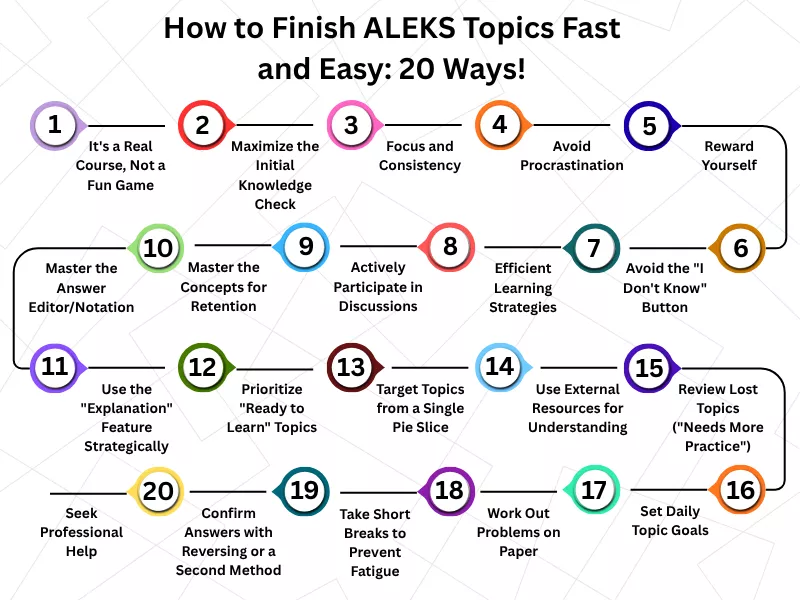
How to Finish ALEKS Topics Fast and Easy: 20 Ways!
1. It’s a Real Course, Not a Fun Game:
The first mistake most students commit is not taking ALEKS seriously. The first step to finding ALEKS topic answers is to accept that it is no game, but a real course that will decide your college fate!
➔ Consequences for Lack of Mastery
Treat the adaptive assignments seriously, as mistakes and incomplete mastery can directly impact your course grade and extend the time required to complete the material.
➔ Focus on Deep Understanding over “Hacks”
The goal is not merely to complete the topics but to master them for your long-term benefit in subsequent exams or courses. Avoid ALEKS learning shortcuts that bypass true learning, as ALEKS will eventually re-test you on those concepts.
2. Maximize the Initial Knowledge Check:

The ALEKS platform can provide personalized topics as per your Initial Knowledge Check report. So, the next tips to speed up ALEKS topics completion are as follows:
➔ Don’t Guess; Use Honesty to Your Advantage
Try your best to solve every problem you can, but don’t guess or cheat by using outside help on questions you really don’t know. If you get a higher score than you should on the first test, ALEKS will put you in a course that is too hard. This will cause you to struggle right away and quickly lose topics when you take later quizzes.
➔ Work Diligently to Claim Pre-Requisite Knowledge
The Initial Knowledge Check is the quickest way to skip topics. For any problem you feel confident about, take the necessary time to work it out carefully on scratch paper to ensure a correct answer. Correctly solving a single problem can credit you with mastery of an entire set of related, foundational topics.
3. Focus and Consistency:
ALEKS is no rocket science; with focus and consistency, you can finish the ALEKS assignments on time and master a topic. This way, you can get answers for ALEKS fast. Furthermore, if your academic level requires you to practice more, you can also start with Pearson and find MyStatLab Answers in the same way.
➔ Create a Study Space, Schedule, and Routine
To do that, you must first create a study space. Believe it or not, your bed or couch is not the ideal study space. Also, although ALEKS was designed for on-the-go study, it’s not suitable because, to pass your ALEKS online course quickly, you need to concentrate and master the topics. Next, for mastering ALEKS topics, create a schedule and stick to it. The planner will help you be on top of your ALEKS assessments, assignments, and quizzes. Lastly, you must have a proper routine that combines your topic segregation, deadlines, free time, fun time, breaks, and maybe even procrastination.
➔ Utilize the Power of Spaced Repetition for Learning
ALEKS classes might seem like a hurdle, but they are not. The best learning strategy for ALEKS is spaced repetition. It is an evidence-based learning technique. It enhances your memory retention by strategically timing review sessions. Instead of cramming all ALEKS math placement test topics, working 30-60 minutes daily ensures better retention, makes the concepts stick, and helps prevent the program from adding lost topics back to your pie. Moreover, when you invest some time each day to complete your tasks, your performance in advanced topics improves.
4. Avoid Procrastination:

➔ Meet Objectives in Small Increments
Instead of trying to finish all ALEKS topics in a day, set realistic and achievable objectives. ALEKS uses AI algorithms to check how much you have achieved, and consistently hitting these small targets prevents overwhelming backlogs and maintains steady forward momentum.
➔ ALEKS Penalizes Inactivity with Knowledge Checks
Procrastinating often triggers a Knowledge Check when you finally log back in. Suppose you haven’t been regularly practicing and reviewing. In that case, this check is likely to cause you to lose track of topics, effectively increasing your total work and slowing your overall completion time.
5. Reward Yourself:
Now this is the best way you can motivate yourself to go on with ALEKS and independently find ALEKS homework answers: REWARD YOURSELF. On the same note, you can actually use these strategies to get MyOpenMath Answers as well to finish them quickly.
➔ Celebrate Topic Milestones
As often said by experts, celebration brings happiness and motivation. While here, you might not have anyone to motivate you, but you can be your own cheerleader. Set up a reward board and keep rewards for each goal. Once you reach your goal and complete each milestone (e.g., 3-5 topics per day), reward yourself. Similarly, for every milestone you miss, you must also let go of the reward!
➔ Use Progress as a Motivator
Thorough practice is crucial to finish ALEKS quickly. However, even after spending so much time and practicing well, you might miss a few ALEKS test topics and end up scoring a little less. In such scenarios, when you do not score well in a quiz or assignment, review your planner, routine, and approach. This will help you get accustomed to the platform as well. But do not get upset, for no setback is big enough to hold your success back!
6. Avoid the “I Don’t Know” Button:

➔ Guarantees Reteaching of Related Concepts
Hitting the “I Don’t Know” button signals to ALEKS a complete lack of knowledge, causing the system to assign not only that specific topic but also all its prerequisite, foundational topics, creating a significantly longer learning path.
➔ Attempt Every Problem to Maintain Topic Ownership
Even if you feel uncertain, attempt to work out a solution on paper. Providing an answer, even an incorrect one, gives ALEKS more data on your specific gaps, allowing it to target your learning more precisely than the blanket re-assignment caused by admitting zero knowledge.
7. Efficient Learning Strategies:
Before you decide to cheat on ALEKS topics, learn a few things about the ALEKS account. No cheat sheets or ALEKS answer key can save you; instead, do this.
➔ Read Guidelines Properly
There’s no way you can complete ALEKS if you do not read the guidelines properly. Start by reading the guidelines and understanding the requirements. Most students miss the instructions and end up using the wrong method which results in them working out the solution all over again.
➔ Understand the Questions
Now that you have learnt and understood the instructions, start by reading the question aloud. This will help you understand the question better and figure out what to do.
8. Actively Participate in Discussions:

➔ Stay Away from Distractions
While online education requires you to use mobile devices, tablets, and laptops, try not to use TikTok or Instagram while working in ALEKS. Keep distractions at bay and focus on your ALEKS knowledge check. This will help you quickly finish your sets.
➔ Be Honest and Remain Dedicated
While you might think shortcuts will help you win, it’s not. Treat every question, whether in the learning path or a Knowledge Check, with complete honesty. Whether you need ALEKS, honesty and dedication will help you complete your homework and finish the coursework diligently.
9. Master the Concepts for Retention:
While memorizing math might not be a great idea, memorizing formulas is!
➔ Prioritize the Why Over the How
Don’t just memorize the steps for a specific problem type. Focus on understanding the core mathematical principle (the “why”) behind the process. ALEKS generates numerous variations of each problem; true conceptual understanding allows you to solve any variation quickly.
➔ Regularly Use the Review Function
Actively engage with the Review function to practice topics you’ve recently mastered. This spaced repetition combats memory decay and ensures that when an automated Knowledge Check occurs, you successfully confirm your retention and prevent those topics from being tagged as “lost.”
10. Master the Answer Editor/Notation:
You must know how to exactly enter the notations so you don’t lose grades or credits because of silly errors.
➔ Double-Check Input for Complex Answers
For problems involving multiple steps or non-integer results, carefully review your final input against your scratch paper. Incorrect notation forces the system to reassign the topic, wasting your time.
➔ Complete the Initial Tools Tutorial Thoroughly
Before starting any real work, spend extra time in the introductory tutorial. Learning the exact syntax for fractions, inequalities, graphing, and exponents is crucial, as ALEKS considers notation errors to be knowledge gaps.
11. Use the “Explanation” Feature Strategically:

➔ Annotate Explanations in Your Notebook
When you read an explanation, jot down the key formula and the steps of the sample problem. This converts the system’s teaching into your personal, searchable resource for future review.
➔ View the Explanation Before the First Attempt on New Concepts
Don’t waste an attempt by diving into a problem you don’t know. Click “Explanation” right away to read the lesson and see the solved example, which is the fastest way to acquire the prerequisite knowledge.
12. Prioritize “Ready to Learn” Topics:
➔ Trust ALEKS’s Algorithm for Efficiency
The “Ready to Learn” topics are precisely those for which the system has confirmed you have the necessary prerequisite knowledge. Focusing here is the most efficient path forward, as you are likely to master them quickly and open up the next logical set of topics.
➔ Use the “Next” Button on the Homepage
After logging in, always click the guided path or “Next” button. ALEKS directs you to the most productive topic at that moment, preventing you from wasting time on concepts that are currently blocked by knowledge gaps.
13. Target Topics from a Single Pie Slice:
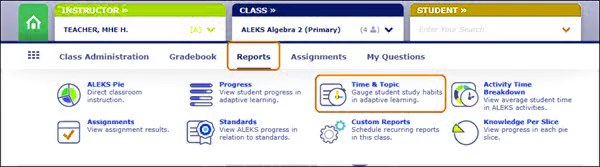
➔ Trigger Rapid Pie Growth
By dedicating a session to one or two adjacent pie slices, you can quickly fill the green area in a specific domain. This focused effort often leads the system to credit you with mastery of larger, overarching topics (the dark color), accelerating your overall progress.
➔ Build Momentum and Confidence
Concentrating your effort allows you to build a rhythm and focus your mind on a single type of math (e.g., trigonometry or algebra), which boosts efficiency and helps stave off mental fatigue from topic-switching.
14. Use External Resources for Understanding:
➔ Search Specific Concept Titles
If you struggle with an ALEKS topic like “Solving systems of linear equations using substitution,” immediately search that exact phrase on YouTube or a learning platform (like Khan Academy). Seeing a different teacher’s explanation can often provide the necessary “Aha!” moment.
➔ Treat Tutors and Study Groups as Quick Clarity Tools
Don’t spend an hour wrestling with a topic you don’t grasp. A quick 5-minute explanation from a peer or tutor can clarify the concept, allowing you to return to ALEKS and master the topic efficiently.
15. Review Lost Topics (“Needs More Practice”):
➔ Address Lost Topics Immediately
The moment a Knowledge Check adds topics back to your “Needs More Practice” queue, prioritize them. These topics are still fresh in your mind, and re-mastering them quickly prevents significant progress regression.
➔ Treat Them as High-Priority Review
Recognizing that the system flagged these topics for a reason, treat them as a non-optional review. Re-mastering them strengthens your foundation and significantly reduces the chance of losing them again in future assessments.
16. Set Daily Topic Goals:
➔ Create a Manageable Daily Quota
Instead of vaguely studying for an hour, aim to master a specific, small number of topics, like 5-7 topics per day. This is a concrete, achievable goal that provides a sense of accomplishment and drives consistent daily progress.
➔ Track and Adjust Weekly Progress
Keep a simple tally of your mastered topics. If you fall behind your goal, add a few topics to the next day’s workload. This helps you stay on track for your overall course completion deadline.
17. Work Out Problems on Paper:
➔ Catch Careless Calculation Errors
Using scratch paper for all calculations forces you to be deliberate and allows you to catch simple arithmetic errors. This drastically reduces the number of problems you get wrong, preventing ALEKS from adding more work based on simple mistakes.
➔ Retrace Steps on Incorrect Answers
If your answer is incorrect, having your work written out allows you to easily identify the point of failure (e.g., a sign error or misapplied formula). This instant self-correction is much faster than guessing or reading a long explanation.
18. Take Short Breaks to Prevent Fatigue:

➔ Implement the 45/15 Rule (or Similar)
Work intensely for a set period (e.g., 45 minutes) and then take a mandatory short, mental break (e.g., 10-15 minutes). This technique ensures peak focus during work time and prevents the decline in accuracy that comes with prolonged staring at a screen.
➔ Exit When Errors Begin to Compound
If you start getting two or three problems wrong in a row on topics you should know, log off immediately. Continuing at this point only leads to inefficient learning and negative data input for the ALEKS system.
19. Confirm Answers with Reversing or a Second Method:
➔ Use Logical Checks
For word problems or statistical concepts, ask yourself, “Does this answer make logical sense in the real world?” A quick logical check can prevent entry errors and ensure you haven’t fundamentally misunderstood the problem.
➔ Verify Algebraic Solutions
For algebraic problems, plug your final answer back into the original equation to ensure it yields a true statement. This quick verification is much faster than getting the answer wrong and being forced to re-master the topic.
20. Seek Professional Help
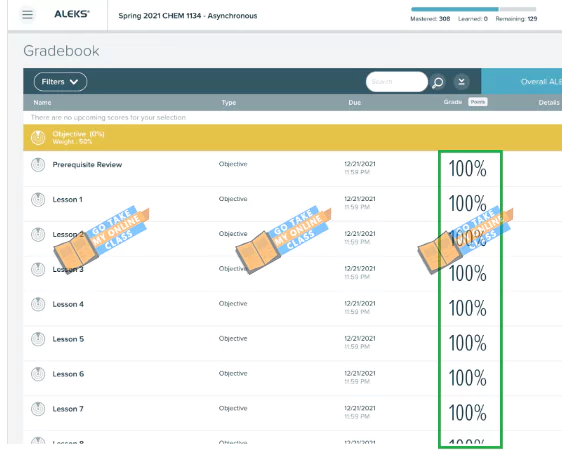
Last but not least, you can always seek professional help. ALEKS is an online learning platform that requires you to know the subjects well and completely understand the topics. Furthermore, as evident from the points above, ALEKS study strategies play a vital role. However, if you are someone who is unable to invest so much time and needs help to get ALEKS answers, then hiring a class taker is the best option. They will not only help you finish ALEKS topics fast but also ensure you get good grades.
To Leave You With,
While we know and understand that online education is much tougher than it seems, with little help and proper ALEKS time management skills, you can ace and get ALEKS done fast. Furthermore, at times when it seems impossible to manage time to complete your tasks on time, you can always fall back on experts experienced with the ALEKS platform. If you wish to know more about ALEKS and pass the course effortlessly, follow our ALEKS category blogs!
Frequently Asked Questions
What Mistakes Slow Students Down in ALEKS?
Common mistakes that slow students down in ALEKS include rushing through assessments, making careless errors, excessively using the “I don’t know” button, working in long marathon sessions that lead to exhaustion, and not paying attention to computer notation input requirements. For example, if students are careless or distracted, ALEKS assumes they do not know the topic and will add it back to their pie chart for more practice. Another mistake is multitasking or juggling ALEKS with other courses, which leads to half-hearted efforts and slower progress. Regular distraction and not using a notebook to work out problems also contribute to slower learning.
Why Avoid Cheating while Taking an ALEKS Math Test?
Cheating on ALEKS is counterproductive and risky. The system is adaptive and designed to assess your true knowledge, ensuring accurate placement. Cheating results in being placed in courses that are too advanced for your actual ability, leading to frustration and poor performance. It also creates knowledge gaps that will hurt future learning since ALEKS topics build progressively. Teachers can detect inconsistencies through detailed reports, which may lead to academic consequences. Ultimately, cheating hurts your own learning and future success.
How Can a Study Plan Help Me Finish My ALEKS Course?
A study plan helps by promoting regular, manageable study sessions rather than cramming. Using ALEKS’s built-in topic scheduler or external planners, students can allocate specific daily or weekly time slots to work on ALEKS—ideally 20-45 minutes per session. This helps avoid fatigue and increases retention. A study plan aids in prioritizing topics, setting milestones, and providing motivation through small rewards, ensuring progress is consistent and efficient.
What Is the Most Effective Strategy to Tackle ALEKS Tests?
Effective strategies include:
- Using pencil and paper to work out problems instead of mental calculations reduces careless mistakes.
- Taking assessments seriously and avoiding the “I don’t know” button unless completely unsure.
- Working in short, frequent sessions to maintain focus and avoid mental exhaustion.
- Using the review function to reinforce mastery on key topics.
- Utilizing tools like organized notebooks to track learning.
- Preparing for assessments by studying topics in advance rather than cramming.
What Is ALEKS, and Why Do Students Struggle to Finish Its Topics Quickly?
ALEKS is an adaptive, AI-driven learning and assessment platform for math and other subjects. It customizes topics based on the student’s current knowledge using sophisticated algorithms, guiding them through topics they are ready to learn next. Students struggle to finish ALEKS topics quickly because the platform requires genuine understanding and practice, not just quick guesses. Errors cause topics to be added back in the learning pie. The system is designed to prevent skipping foundational knowledge, so quick completion without comprehension is difficult.
Is It Possible to Finish ALEKS’s Topics without Fully Understanding Them?
While it may be tempting to try to finish topics quickly without full understanding, ALEKS’s design makes it challenging. The platform’s adaptive assessments will detect gaps through repeated questions and reassessments, often reverting topics to the learning queue if you skip mastery. This leads to frustration and slower overall progress. Moreover, a lack of understanding affects future topics that build on the skipped concepts. The best approach is mastering topics gradually for sustained progress.

Want To See My Profile — Check Now
- How to Get IXL Answers the Right Way? - November 27, 2025
- How To Cheat On MyMathLab To Get MyMathLab Answers? - November 26, 2025
- Why MathXL Answers Cheat Doesn’t Work: Study Smarter - November 25, 2025