According to data from Bay View Analytics (2023), the failure rate for online courses is typically 15% higher than that of traditional classes. Studies have revealed that the reality of the situation is actually due to heavy workloads, procrastination, tech issues, isolation, and burnout.
So, if you fail classes, it is not due to a lack of intelligence. You are failing your online classes because the “lonely learner” trap exists in the online world. But don’t panic; this is a setback, not a defeat. Just a better system is needed.
Let’s get to the bottom of it and take the easy steps you can take to get back on track today.
Key Takeaways on Failing Online Classes
- Know that virtual courses require additional self-directed study time.
- Avoid procrastination by setting a strict schedule for the week.
- Become familiar with your Learning Management System so that you don’t miss out on important grade updates.
- Find peer support and mentorship and end the sense of digital isolation.
- Seek professional or study support when it gets too difficult.
Reasons Why You Are Failing Your Online Classes
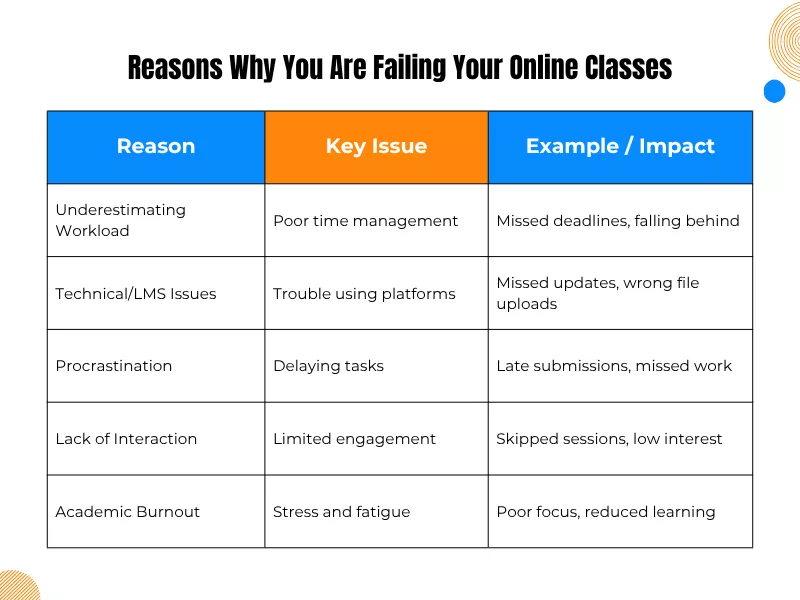
Knowing the reasons for failing online classes is the first step to saving the semester.
1. Underestimating the “Asynchronous” Workload
Many students make the mistake of thinking online college courses are easier than in-person ones. In fact, according to the National Center for Education Statistics (NCES), distance learning demands much greater self-teaching. You are not accompanied by a professor, so you’re on your own to absorb difficult information.
For example, you are making mistakes like:
- Considering “self-paced” as “no-deadline” zones.
- Failure to estimate the 3:1 ratio (3 hours of study to 1 credit hour).
This disorganization leads you to fall behind at the beginning of the semester.
2. Technical Friction and LMS Fatigue
Technical problems are among the most common reasons for an online student giving up on the course, according to a ResearchGate survey.
Technological issues can escalate from minor to major online class problems.
You may miss out on important syllabus updates or grading rubrics on time if you are not used to using your school’s digital portal. For example, you missed a “hidden” notification or feedback in the gradebook.
Also, you ignorantly uploaded incompatible file formats that professors can’t open.
When the LMS interface feels like a foreign space, the motivation jumps out of the window! This makes struggling and failing online classes feel inevitable.
3. The Digital Procrastination Loop
Dr. Piers Steel, a top researcher in the field of motivation, has found that in the absence of physical supervision in online education, students tend to be highly prone to procrastination.
For instance, waiting till the last minute to log into your LMS is a primary reason students fail online courses. Examples include: submitting high-stakes assignments at 11:58 PM or skipping weekly forum posts till the weekend.
The immediate consequence of failing to avoid procrastination on online class is a “0” for missed windows. Hence, this habit is the reason why you are failing the class.
4. Lack of Social and Cognitive Presence
Without “social presence,” distance learning is lonely and burdensome, as demonstrated by the Community of Inquiry model of D. Randy Garrison, Terry Anderson, and Walter Archer, pioneers in distance education research.
Without interaction with others or virtual office hours, you will not receive the so-called “hidden curriculum,” which includes the tips and clarifications that occur naturally in a physical classroom.
For example, an online student often skips optional Zoom sessions or peer study groups, and they rarely get a make-up session.
This leads to disengagement and losing interest, which eventually leads to grades dropping rapidly.
5. Unmanaged Academic Burnout
Many students will drop out of school or fail classes for a variety of different reasons, one of which is stress.
Juggling life and work with a screen can cause debilitating stress. High cortisol literally impairs the brain’s ability to hold on to new information. As a result, you go through symptoms like
- Experiencing “zoom fatigue” and digital eye strain.
- Not sleeping because of access to course materials 24/7.
To keep your GPA safe, you must learn to deal with college stress effectively. If you don’t feel good, you don’t learn well.
What Should I Do If I’m Failing My Online Classes?
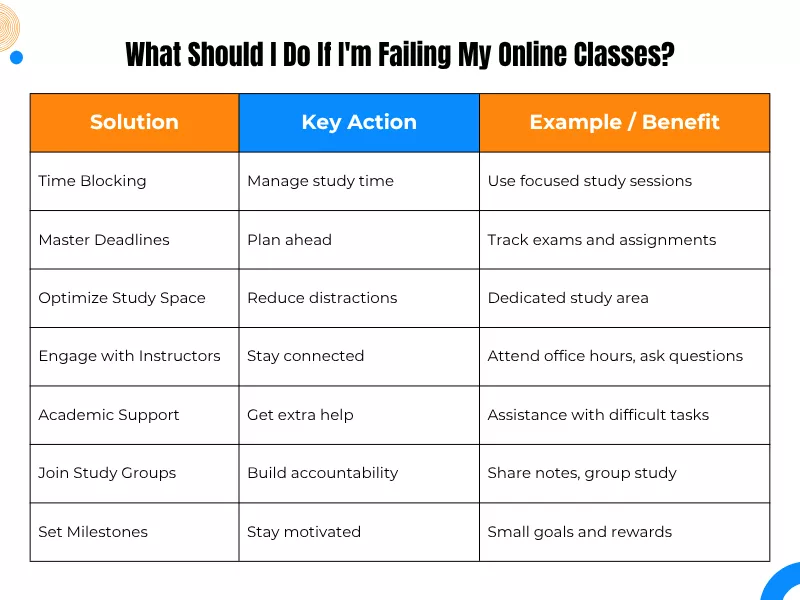
1. Use Time Blocking to “Deep Work”
Achiever students taking online courses practice time-blocking as a tool to overcome a heavy workload. The Journal of Educational Psychology study indicates that good time management leads to better retention. Rather than “studying all day,” set aside particular hours for a given task. Here are some tips:
- Schedule coursework on Google Calendar with color-coded blocks by task type (reading, assignments, discussions).
- Use the Pomodoro method — 25 minutes focused, 5-minute break — to beat the urge to scroll.
- Set a personal deadline 48 hours before the actual due date as your buffer for tech issues.
A fine schedule ensures that you aren’t missing assignments and you are managing your time well.
2. Master the Syllabus and High-Stakes Deadlines
One of the best ways to pass online classes is to “front-load” your preparation. Prepare ahead of time for the semester by scheduling all the high-stakes exams and papers on your syllabus from the beginning.
- Be sure to check all dates against your personal work or life events.
- Study the grading rubrics before starting any major project or assignment.
- Look for particular citation needs, such as APA, MLA, and others, early on.
When you know exactly what your professor is looking for, you will get more points for every submission!
3. Optimize Your Digital Study Environment
Your physical environment can affect your ability to do well in online degree programs. Household distractions and poor ergonomics may make it difficult for students to concentrate. A specialized workspace informs your mind when it’s time to work.
- Establish a desk, away from bed or busy living spaces.
- Make sure that the internet connection is stable and fast before taking any exams in school or university.
- Keep noise-canceling headphones to help focus in noisy environments.
A “study-only” area will provide motivation to continue before digital fatigue kicks in.
4. Engage Through Virtual Office Hours
In an online college program, your professor isn’t just a name in an email. Effective online class success strategies involve building a real rapport with instructors. This “social presence” bridges the gap that causes many to fail.
- Email specific questions at least 48 hours before a deadline.
- Request a 10-minute video call to clarify complex grading feedback.
- Show active participation in discussion boards beyond the minimum requirement.
Showing this level of commitment makes professors more likely to offer flexibility when you seek help.
5. Hire Professional Academic Support to Avoid Failing Your Online Classes
When the workload becomes impossible to manage, specialized services are available online to provide a safety net. If you are overwhelmed, you can choose to take my online class to ensure your GPA remains competitive while you catch up.
- Get expert assistance for complex math, science, or nursing modules.
- Ensure your weekly discussion boards and quizzes are submitted on time.
- Get help meeting strict “midnight” deadlines during busy work weeks.
This allows you to invest in your academic future when you reach a mental breaking point.
6. Join Collaborative Groups
Many online platforms, like Canvas or Blackboard, require students to participate in forums. Make use of these virtual environments to find study partners. When someone is struggling and failing online classes, it is often due to a lack of peer accountability.
- Use Canvas Groups or Blackboard Collaborate to find classmates in the same course section.
- Post in your school’s Reddit community (e.g., r/[YourUniversity]) or Facebook student groups to find study partners.
- Use shared Google Docs to build a collaborative study guide before finals.
Working with others helps avoid the isolation and helps you stay on track to get your degree.
7. Know Your Academic Safety Nets
If you’re at risk of failing, US students have more options than they realize. Most schools allow course withdrawal until a set deadline without a grade penalty — check your registrar’s site for the “W” grade cutoff date.
Falling below a 2.0 GPA typically triggers academic probation, which can affect financial aid eligibility under FAFSA rules. Contact your academic advisor early — NACADA is a trusted resource for understanding your options.
8. Set Milestones
To reach graduation, you must take steps to stay mentally sharp and focused. Online learning requires a lot of discipline, which is much easier to maintain when you have clear, smaller milestones to celebrate.
- Make a daily target to learn certain modules or chapters.
- Take a break or give yourself some sort of treat when you have finished a challenging paper or specific goal.
- Keep an eye on your cumulative GPA to see where you stand towards graduation.
The final line is your mental edge to deal with the everyday grind of digital learning.
Conclusion
You now know how to pass online classes by fixing your routine and seeking support. Turning your grades around is possible with the right mindset. For many undergrad students, virtual learning isn’t as flexible as it first seems. Whether you email your professor today, book a free tutoring session, or talk to a counselor about burnout, the move is to act now. Most US campuses offer free mental health support covered by your student fees — use it. You deserve to graduate with pride.
Need more guidance on succeeding in your online courses? Explore GoTakeMyOnlineClass for study tips and academic support.
Frequently Asked Questions About Failing Your Online Classes
Can I recover from failing online classes mid-semester?
Yes. Look at your syllabus and see what assignments are still highly weighted. Talk to your teacher right away about extra credit or extensions. Most instructors and classmates will be happy to assist you if you are trying hard. Do not try to cram a lot of things in one day; do the important things first.
How much does online class help cost for failing students?
The price depends on the complexity of the topic and the time constraints. In general, prices will vary depending on whether you require assistance with a single paper or a whole module. Hiring professionals will help you get the credits you need without having to pay for another term.
How do I find reliable online class help?
Be sure to find services that have valid testimonials and are open about communication. Reliable help brings immediate access to specialists familiar with the particular campus needs. Make sure they provide assurances regarding deadlines and grading to keep you happy and in good academic standing.
How does the pace of online learning differ from in-person classes?
Many don’t know what to expect regarding the speed of digital modules. Unlike in-person classes, the pace is generally faster than in the classroom, and independent reading is encouraged. Getting connected to online communities is the key to success when you’re not in a classroom.
What should I do if I feel overwhelmed by the transition to digital learning?
Students feel lost when switching to virtual platforms if this is common. Talk to your academic advisor about a manageable number of classes or other ways to study. Keep in mind that the end goal is learning and graduation – take care of your mind on the way. Many US campuses include free counseling sessions under student fees — search ‘[your school name] counseling services’ to book an appointment.

Want To See My Profile — Check Now
- 6 Tips to Create the Perfect Study Environment at Home (2026) - May 26, 2026
- Why You’re Failing Your Online Classes and How to Fix It - May 20, 2026
- How Much Does It Cost to Pay Someone to Take My Online Class? - April 24, 2026