Yes, Moodle can detect cheating and prevent it, primarily by using third-party plugins, specialized quiz settings, and proctoring tools. The learning platform typically utilizes browser lockdown, IP tracking, and analytics to monitor user behavior. However, it cannot detect cheating independently.
Since most students often wonder, can Moodle detect cheating, whenever they are struggling with tests, quizzes, and exams, we are here to help them out with it. In this blog, we will understand what Moodle is, along with all the ways it uses to detect and prevent cheating.
Also, we will share a few ways that can help you bypass the platform and get the answers.
Key Takeaways
- Moodle cannot detect cheating independently but tracks logs, timing, and IP activity.
- Detection mainly depends on tools like Turnitin, Proctorio, and Respondus Monitor.
- Proctored exams may use webcam monitoring, screen recording, and browser lockdown.
- Randomized questions and time limits help reduce cheating opportunities.
- Cheating can result in failing grades, suspension, or expulsion.
What Is Moodle?
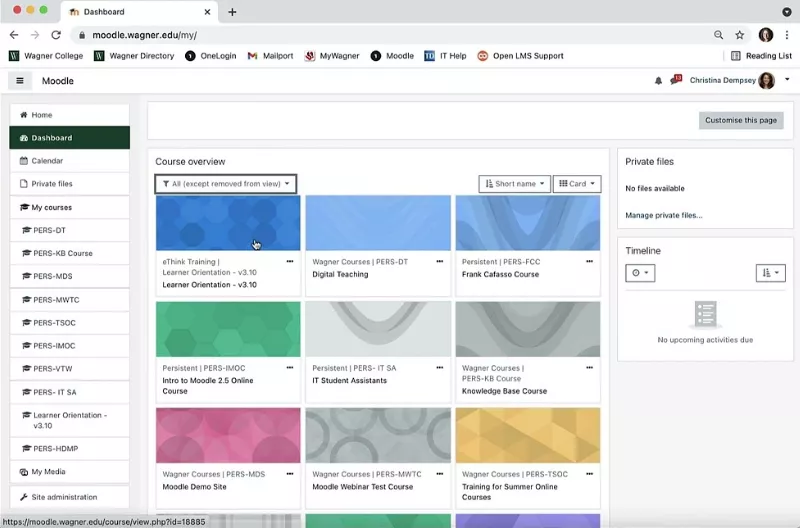
Moodle (Modular Object-Oriented Dynamic Learning Environment) is one of the most popular free, open-source learning management systems.
The LMS is used by a number of schools, universities, and workplaces worldwide, enabling educators to create private websites, manage courses, deliver content, track student progress, and facilitate interactive, collaborative learning.
That will help you know what Moodle is all about. If you are using the platform now, you will already know its features. Yet, very few know what and how the platform detects cheating.
To start with, we will take you through what the platform can detect on its own.
What Can Moodle Detect on Its Own?
Though we have said that the platform cannot detect cheating independently, there are a few things it can do to prevent it. So, before we talk about how it detects cheating using third-party plugins, we will take you through the things it can prevent on its own:
A. Activity Logs
The system can track when a student logs in, the resources they click on, and when they submit their assignments. These give the system an idea of what you are doing, and in case of any suspicious activities, the system flags them immediately.
B. Quiz Security
Moodle can track how much time you spend on each question. This helps understand if you are using any unfair means to cheat on the platform. If you are spending a few seconds solving a complex question, it suggests that you are not solving the problem yourself. It also logs IP addresses, thus restricting navigation.
C. Assignment Submission Time
The platform keeps track of the assignment submission time. If you are submitting the task after the deadline, you will be penalized for the same. Although this is not a way to prevent cheating, it keeps track of deadlines, which will affect your grades.
As far as the assignments are concerned, the take my online class for me experts can help you with that. While they can help you with the entire online classes, it is crucial to ask for help when deadlines are knocking at your door.
What Moodle Can Detect with Third-Party Tools?
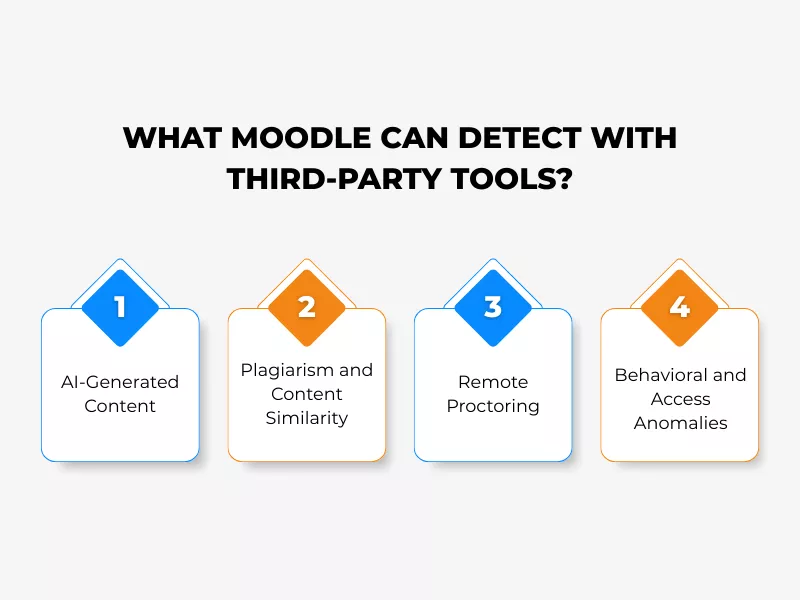
The platform can actually detect cheating with the help of third-party tools and plugins. Let’s take you through the things it can detect with the third-party integrations:
A. AI-Generated Content
The LMS can analyze student submissions for AI-generated content with the use of plugins like Originality.ai, CopyLeaks, and other such tools. These tools can help detect AI-generated content and do a sentence-by-sentence analysis. Some of the plugins claim to be highly accurate in detecting content from various AI models.
B. Plagiarism and Content Similarity
Integrating Turnitin, UniCheck, PlagScan, and CopyCheck scans assignments against extensive databases. These can detect various forms of plagiarism, including direct copying, patchwork, and paraphrasing. The LMS uses these tools to detect plagiarism. No Moodle or MyOpenMath hack can work in such cases.
C. Remote Proctoring
The learning platform integrates remote proctoring tools like Proctorio, Respondus Monitor, and HonorLock to offer advanced monitoring during quizzes. These tools can record student behavior, detect if a student looks away from the screen, or identify unauthorized persons. Many students, therefore, look for ways to cheat on Respondus Lockdown Browser or other proctoring tools. So, if you ever wonder how does Moodle detect cheating in quizzes, you must refer to its remote proctoring techniques.
D. Behavioral and Access Anomalies
The third-party analytics tools can help detect unusual patterns. These tools can monitor IP addresses and detect timing anomalies that might suggest cheating.
This will help you understand what the platform can detect and how it does so. Moving on, we will take you through a few points that will help you understand if a Moodle exam is proctored.
How to Know if Moodle Exam Is Proctored?
The first things to look for to understand if a Moodle exam is proctored or not are the instructions in the quiz description, the requirement of a password, browser lockdown, or prompts to enable your webcam/microphone.
In addition to this, a few additional indicators include:
A. Pre Check/System Requirements
If you are asked to perform a system check for the webcam, microphone, and browser, the test is proctored. This is one of the primary indicators that suggest that the Moodle exam is proctored.
B. Webcam/Screen Capture
In case of proctored exams, Moodle states that it will take photos, record videos, or record your screen during the exam. You need to be careful if you see a message getting displayed on your screen.
C. Browser Lockdown
Proctored exams often require students to use a specific browser that restricts them from navigating away from the page. Check if you are instructed to use a specific browser; it is the biggest indicator that your test is proctored. It is also how Canvas detects cheating.
D. ID/Room Scan
Proctored exams may require students to show their photo ID or perform a 360-degree room scan before starting. So, when you are asked to show your ID or do a room scan, know that the exam is proctored.
Before we call it a day, let’s take you through a few points that will further help you understand what Moodle detects and what it doesn’t.
Can Moodle See if You Switch Tabs?
One of the important questions every student has is, can Moodle detect switching tabs? You will be relieved to know that Moodle cannot detect tab switching on its own. The learning platform can only track page loads and clicks within its own system.
However, if your instructor is using any specialized proctoring tools, external plugins, or a secure window setting, it can detect, flag, or prevent tab switching.
Does Moodle Monitor Your Screen?
The answer is the same as the one above: Moodle cannot monitor your screen, record video, or track your activity outside its own browser tab. But here again, if your institution has integrated any proctoring plugins, your screen and webcam can be monitored during exams.
While it’s a relief that the system cannot monitor your screen by itself, you must also remember that during exams, it integrates proctoring tools to keep track of your activity.
How Moodle Quizzes Are Designed to Prevent Cheating?
The learning platform does not have any features to prevent cheating by itself. Yet, there are a few features of the platform that can be considered as anti-cheating features:
A. Randomized Questions
Questions are mostly randomized on the platform. So, if you think you can ask your friend for an answer, you will not be able to get the correct one, since both of you are working on different questions. This is mostly common for all platforms and is a reason students struggle to find MindTap answers as well.
B. Time Limits
There are specific time limits and fixed open/close dates that minimize opportunities for students to collaborate or look up answers.
C. Hiding Review Summaries
The platform does not allow students to see answers after submission. This is a major anti-cheating feature of Moodle, as students cannot find any loopholes to get the answers.
D. Open-Ended Questions
Moodle creates open-ended questions for students, making it difficult for them to copy, and often requires original thinking.
By now, you have a clear idea about what the platform does to prevent cheating. However, for those who feel there will be no consequences if they are caught cheating, the following section is specifically for you.
How to Hack Moodle Answers: Some Tricks And Methods
One of the probable ways is to use course materials. In this way, you can get many answers.
- Collect all the lecture and course materials.
- Make a PDF or Word document that contains all the information.
- While solving the Moodle questions, open the document on one side and the portal on another window.
- You can search for the question with some keywords using Ctrl+F. In this way, you can find some information for the question.
- You can also search for the question on Google.
How Students Can Bypass Moodle Quiz Cheat Detection?
Cheating on Moodle isn’t that easy, though, since tremendous punishments prevail when one gets caught. Nevertheless, there are just a couple of loopholes and trickery where one bypasses the cheat detection process. Some of the tips and tricks include:
- Gather the necessary study materials on another laptop. You can access them while taking the online quiz.
- You can also print the study materials so you don’t have to switch tabs.
- Try to rephrase the answers thoroughly, as colleges use plagiarism detection software that will detect if you simply copy and paste them. Also, note that in 2026, many institutions use AI detection tools in addition to plagiarism tools, making thorough paraphrasing even more important.
- Another way to make sure you pass with high grades is to hire professionals to take the quiz on your behalf.
What Happens if Moodle Flags You for Cheating?
The consequences of cheating can be severe. If you are caught cheating on Moodle, the consequences you might face include:
- Immediate academic action – A zero or failing grade in the assignment or exam
- Course failure – An ‘F’ grade for the entire course
- Disciplinary measures – Academic probation, suspension, or expulsion from the institution
No one would want to face such consequences, right? As promised, we will share a few loopholes that can help you bypass the system and get the answers.
Moodle’s Limitations – What It Can’t Detect
We would like to reiterate that the platform alone cannot prevent cheating. However, with the integration of proctoring tools, it can detect cheating. Here are a few things the platform cannot detect:
- If you are using a secondary device or physical notes
- If there’s someone else in the room to help you get the answers
- Paraphrased or AI-written content to a certain extent
- Cross-device activity without proctoring
Those are your options to get around the system. What we suggest? We suggest you get help from the experts at GoTakeMyOnlineClass. They have a proven track record of helping students get answers to all the problems.
Final Thoughts,
To put all the things in a nutshell, Moodle can detect cheating with the help of proctoring tools. The platform cannot detect cheating by itself. However, it has a few anti-cheating features to prevent students from using any unfair means.
So, if you feel you can cheat on the platform, think again. Instead of taking such risks, get help from the experts to find the answers and get good grades.
Frequently Asked Questions
Can Moodle detect copy and paste?
Yes, Moodle can detect copy and paste, but it relies on specific settings, third-party plugins, or proctoring tools enabled by your instructor.
Can professors see what you access on Moodle?
Yes, professors and instructors can see nearly everything you access, download, or interact with on Moodle.
Does Moodle work the same way at every institution?
No, the platform is open-source; institutions can configure it differently. Everything on the platform depends on how the institution sets up everything.
Does Moodle notify you if you are flagged for cheating?
No, Moodle does not notify your instructors if you are flagged for cheating. The instructors have the option to review the flagged data and decide whether to escalate the data through the institution’s academic integrity process.
Related Blogs

How to Get IXL Answers the Right Way?

How To Cheat On MyMathLab To Get MyMathLab Answers?

Best Ways To Start A Conclusion Paragraph Starters – Essay Conclusion Starters

- Can Moodle Detect Cheating? Complete 2026 Detection Guide - February 27, 2026
- How to Cheat on MyOpenMath Answers: 9 Hacks that No One Talks About - February 24, 2026
- Is Hiring an Online Class Helper Legit? - February 19, 2026