ADN nursing is an undergraduate nursing program. Its curriculum is designed to train students for RN licensure. Depending on the school, the ADN program is often renamed as Associate of Science in Nursing (ASN) or Associate of Applied Science in Nursing (AAS-N). In this guide, you will learn what is an ADN in detail, alongside other details like the duration of an ADN program, the coursework required for an ADN, the cost of an ADN, what an ADN nurse does, and an ADN vs BSN comparison.
Is Economics or Finance More Math-Heavy? A Quick Summary
- Economics is likely to be more math-heavy, as it requires theoretical and continuous math like multivariable calculus, linear algebra, and econometrics.
- A finance major focuses on applied math, and it relies on practical arithmetic, ratios, time value of money, and Excel financial modeling.
- Economics uses calculus for theoretical proofs and optimization; on the other hand, finance uses applied algebra and metrics.
- A B.S. in Economics tends to be more math-intensive than a B.A. or a standard Finance degree, though the exact quantitative gap varies by institution and track.
- Choose Economics if you excel at abstract math; choose Finance for concrete business problem-solving.
Importance of Understanding Economics
Economics is a social science that studies the relationship between individuals, businesses, governments, and the overall economy, and how society allocates scarce resources. Unlike finance, which centers on private wealth and corporate balance sheets, economics analyzes human behavior at a broader level and examines how markets operate as a whole.
Economics gives you insight into the larger forces driving markets, public policy, and social problems.
Importance of Understanding Finance
Finance is the discipline that studies how people and businesses manage their assets, investments, and risk. It is critically important to understand finance, as it provides a solid foundation for corporate management, as well as guiding investment decisions for individual investors.
A finance degree gives you tools used directly on Wall Street, in corporate treasury departments, and in managing your own portfolio.
What Does an Economics Major Focus on?
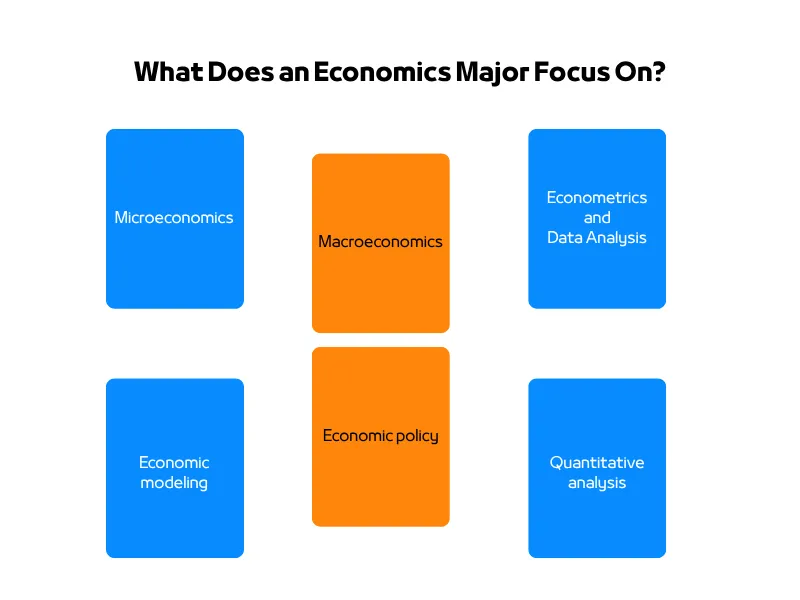
An economics major explores the methods by which individuals, companies, and governments make choices regarding limited resources. The field’s primary areas of study include the following:
- Microeconomics: Microeconomics studies individual customers and companies, market structures, pricing, and supply-demand dynamics.
- Macroeconomics: It examines aggregate aspects of the economy such as trade, inflation, business cycles, and employment.
- Econometrics and Data Analysis: Uses statistical tools to test hypotheses and economic models, establish cause-and-effect relationships, and analyze trends. In essence, students learn to evaluate economic data sets using analytical and statistical techniques.
- Economic modeling: It refers to the application of mathematical and statistical tools to economic data to analyze business and market trends. This area also deals with testing hypotheses about economic relationships and trends.
- Economic policy: Depending on the program, students may study taxation, government spending, international trade, labor markets, or public policy.
- Quantitative analysis: It entails a comprehensive application of mathematical and statistical methods in economics. A background in mathematics is required at the BA and BS levels, and the intensity varies between different institutions.
Economics is a social science concerned with understanding the forces that shape business and market trends. At this level, mathematics plays a critical role in supporting the discipline, facilitating prediction, statistical analysis, modeling, and objective decision-making.
Students may have to navigate automated homework portals like Pearson or Cengage, and it can be confusing when the questions require precise inputs. You can find MyEconLab Answers so you don’t lose points on tough homework modules.
What Does a Finance Major Focus on?
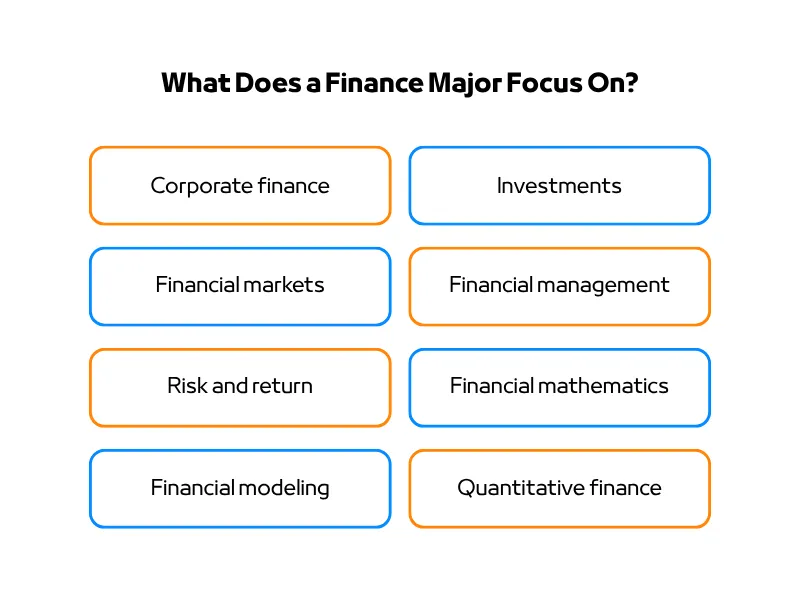
- Corporate finance: Financial decisions related to funding, investment, budgeting, and business.
- Investments: Study of different types of investments, stocks, bonds, investment funds, returns, and various aspects of portfolio composition.
- Financial markets: Examines how markets and institutions operate, and how capital moves through the economy.
- Financial management: Analysis and use of financial information and decision-making about the resources of a company.
- Risk and return: Study of the relationship between the risk and reward of different investments.
- Financial mathematics: Study of financial transactions, including interest rates, present and future values, returns, and other financial indicators.
- Financial modeling: The study of applying quantitative finance techniques and spreadsheet modeling to investment and business decisions.
- Quantitative finance: A more specialized study of probability theory, derivatives, and portfolio management.
The mathematical basis of finance is closely related to the study of financial transactions, the value of assets, the calculation of returns, and the evaluation of different investments and risks.
Which Major Requires More Math: Finance or Economics?
Both Economics and Finance are quantitative fields of study; therefore, it is necessary to take a number of different math-related classes in order to achieve a degree in either of them. However, depending on the institution, the track within the major, and the elective courses that one chooses, the amount of math in either major may vary significantly.
| Math Area | Economics | Finance |
|---|---|---|
| Algebra | Common | Common |
| Statistics | Common | Common |
| Calculus | Common in many programs | Commonly required (business calculus) |
| Econometrics | Often an important component | Usually less central |
| Financial mathematics | Less central | Common |
| Mathematical modeling | Common | Common |
| Probability | Common | Common |
| Optimization | Used in economic models | Used in some financial applications |
| Quantitative analysis | Strong emphasis | Strong emphasis |
Whether your degree focuses on theoretical continuous calculus or applied corporate financial formulas, managing weekly assignments can become demanding. If balancing work, life, and heavy problem sets becomes unmanageable, opt to take my online class and keep your degree progress on track.
What Math Courses Do Economics Majors Take?

The mathematics required for an economics degree, particularly a Bachelor of Science (B.S.) track, can be rigorous and abstract, and some B.S. and math-economics tracks include proof-based work. Many B.S. programs require multivariable calculus and econometrics software.
As a result, students often struggle to keep up with the workload. If you are overwhelmed by demanding problem sets, you can hire experts to take my online Economics class to stay on top of your coursework.
Common math courses required for an economics degree:
Calculus I & II:
Single-variable calculus focusing on limits, derivatives, integrals, and marginal analysis.
Multivariable Calculus (Calculus III):
Essential for microeconomic theory, dealing with partial derivatives and constrained optimization (e.g., Lagrange multipliers).
If you are wondering how do I solve my math problem, online class experts are there to guide you step-by-step through complex equations and tough homework modules.
Linear Algebra:
Focuses on vector spaces and matrices, essential for multi-equation macroeconomic models and multivariate statistical analysis.
Differential Equations:
Used in advanced macroeconomic modeling to analyze economic dynamics and growth over time.
Econometrics & Economic Statistics:
Merges mathematical statistics with software tools like Stata, R, Python, and SPSS to run multivariate regressions and hypothesis testing.
Is a BA or BS in Economics More Math-Intensive?
The B.S. in Economics includes more math than the B.A. At some institutions, the difference may not be significant; at others, it can be substantial.
B.S. in Economics: A B.S. in Economics is designed to provide students with a quantitative basis for understanding economic theory and to develop their analytical skills. As a result, students need to take more advanced classes, such as multivariable calculus, linear algebra, differential equations, and econometrics. It relies on statistical software such as Stata or R to estimate models and analyze dynamic market systems, alongside analytical proof work.
Students may face complex tests and proof-based assessments in linear algebra and differential equations. If your job keeps you busy, but you need to finish your economics test, you can always rely on a pro to take my economics exam and help you get through the class.
B.A. in Economics: Focuses more on qualitative theory, public policy, economic history, and humanities. Math requirements are often limited to basic introductory calculus and standard business statistics, though some B.A. programs require calculus-based intermediate theory.
Math Courses Required for a Finance Degree

Finance math is heavily applied, formulaic, and focused on corporate decision-making and asset pricing. Constructing discounted cash flow models and managing weekly finance quizzes can become time-consuming. If you want a simplified solution, reach out to professional tutors who can step in to take my online finance class and handle your financial coursework.
Common math requirements for a finance degree include:
Business Calculus:
A simplified, practical version of Calculus I that covers basic derivatives and rate-of-change applications without abstract theoretical proofs. Students often complete these coursework modules through platform-based problem sets like WeBWorK math problems, where entering precise calculations is essential.
Business Statistics:
Applied statistics focusing on probability distributions, sample means, standard deviation, variance, and simple linear regression.
Financial Accounting & Management Math:
Algebra-heavy coursework centered on balance sheets, income statements, and financial ratio calculations.
Applied Corporate Finance Math:
Mastering calculations for Time Value of Money (TVM), Net Present Value (NPV), Internal Rate of Return (IRR), and Weighted Average Cost of Capital (WACC).
Financial Modeling:
Utilizing Microsoft Excel and financial calculators to construct valuation models, discounted cash flow (DCF) models, and portfolio optimizations.
Economics vs Finance: Which One Requires More Statistics?
Economics
- Econometrics: Uses statistical methods to test economic theories and relationships.
- Regression analysis: Helps examine how variables such as income, prices, employment, or demand are related.
- Economic data analysis: Students may work with large datasets to identify trends and evaluate economic outcomes.
- Hypothesis testing: Used to determine whether observed relationships in economic data are statistically meaningful.
- Statistical modeling: Can become more advanced in quantitative economics and econometrics courses.
Finance
- Investment analysis: Statistics can help evaluate returns, volatility, and investment performance.
- Risk analysis: Statistical methods help assess uncertainty and potential financial losses.
- Portfolio analysis: Students may use quantitative measures to compare assets and portfolio performance.
- Probability: Supports analysis of financial outcomes and risk.
- Financial modeling: Statistical information can be incorporated into models used for investment and business decisions.
Economics places more emphasis on statistical modeling through econometrics, while finance applies statistics directly to investments, markets, risk, and financial decisions. The difference is not absolute, as advanced finance and quantitative finance programs can involve substantial statistical work.
Economics vs Finance: What Software and Tools Do Students Use?
Common Economics Tools
- R: Used for statistical analysis, econometrics, data manipulation, and economic research.
- Stata: Commonly used for regression analysis, econometrics, and working with economic datasets.
- Python: Used for data analysis, statistical modeling, automation, and quantitative research.
- SPSS: May be used for statistical analysis and research projects.
- Spreadsheets: Excel and similar tools can help students organize data, perform calculations, and build models.
Common Finance Tools
- Microsoft Excel: Mainly used for financial calculations, valuation, budgeting, forecasting, and financial modeling.
- Financial calculators: Used for calculations involving interest rates, present value, future value, loans, and investment returns.
- R and Python: These are used for statistical analysis, portfolio analysis, financial modeling, and quantitative finance.
- Statistical tools: May support risk analysis, investment research, and quantitative financial analysis.
Economics vs Finance: Key Differences at a Glance
| Area | Economics | Finance |
|---|---|---|
| Main focus | Markets, economic behavior, and resource allocation | Money, investments, capital, and financial decisions |
| Typical subjects | Microeconomics, macroeconomics, econometrics, economic policy | Corporate finance, investments, financial markets, risk management |
| Use of mathematics | Modeling, optimization, statistics, and economic analysis | Valuation, financial calculations, statistics, and financial modeling |
| Calculus | Often used in advanced economic theory | Commonly required (business calculus); more advanced in quantitative finance |
| Statistics | Important for econometrics and data analysis | Important for risk, investments, and financial analysis |
| Data analysis | Used to test economic relationships and theories | Used to evaluate financial performance and investment decisions |
| Common tools | R, Stata, Python, and statistical software | Excel, financial calculators, statistical tools, and modeling software |
| Typical quantitative emphasis | Can become highly theoretical and mathematical | Usually more applied, though quantitative finance can be highly mathematical |
Which Major Should I Choose?
There is no particular choice that will suit every student. The better choice depends on the type of quantitative work, subjects, and career direction you prefer.
Consider Economics If You Prefer:
- Understanding why markets and economies behave in certain ways.
- Studying microeconomics, macroeconomics, econometrics, and economic policy.
- Working with statistical data and economic models.
- Exploring how government policies and market changes affect economic outcomes.
- Using mathematics for modeling, optimization, and analytical reasoning.
- Taking a more quantitative route through a B.S. or specialized economics program.
Consider Finance If You Prefer:
- Applying quantitative methods to money and financial decisions.
- Studying investments, corporate finance, financial markets, and risk.
- Working with financial statements, valuation, and investment returns.
- Building financial models and using spreadsheets for practical calculations.
- Applying mathematics to business and investment problems.
- Exploring specialized areas such as quantitative finance, derivatives, or portfolio management.
Before Choosing, Check the Actual Curriculum
Do not base your decision only on the major’s name. Compare the curriculum at the universities you are considering. Check:
- Required calculus and statistics courses
- Econometrics or quantitative finance requirements
- BA vs BS degree structure
- Required software and data-analysis courses
- Available electives and specializations
- Whether advanced mathematics is required or optional
Your university’s course requirements can make a significant difference to the actual mathematical workload of an economics or finance degree.
Aligning Your Career Path with the Right Quantitative Major
If you like to apply established formulas to real-world business problems, then a Finance degree is for you — most tracks rarely use theoretical calculus, though quantitative finance concentrations are an exception.
However, if you want to learn how to think through abstract problems, prove mathematical theorems, and perform multivariable calculus and in-depth statistical analyses, then consider majoring in Economics.
You will be introduced to a lot of complex quantitative material while completing your major on platforms such as Pearson MyMathLab, MyStatLab, Cengage, or McGraw Hill Connect.
If you need help with calculus problem sets, financial modeling, or econometrics, GoTakeMyOnlineClass offers expert guidance with demanding quantitative coursework.
Frequently Asked Questions
Economics or finance: Which is the best major for students who are good at math?
If you are good at math, then the B.S. in Economics or quantitative economics is the way to go since it prepares you better for quantitative work and higher-level study than the B.A. does. This major gives you a solid foundation for pursuing careers in data science, quantitative analysis, and graduate studies in economics.
Is Economics Harder Than Finance Mathematically?
Usually yes—when evaluating overall economics major vs finance major difficulty, the pure mathematical rigor required for economics often tips the scale. The primary reason comes down to how calculus in economics vs finance is actually used:
Calculus in Economics is used theoretically to prove economic theories, conduct elasticity calculations, and perform other continuous multivariable mathematical operations such as optimization using Lagrange multipliers.
In finance, calculus is used to price options via the Black-Scholes formula and, by extension, in derivatives pricing. Some of the quantitative concepts in finance such as bond pricing, annuities, net present value, discounted cash flow, and loan amortization are largely algebraic and do not require calculus.
Do finance majors need to know advanced calculus?
Generally, no. Most undergraduate finance programs require only one or two calculus courses, typically business calculus. Quantitative finance and investment analysis tracks are the exception.
Can I switch from an economics major to a finance major easily?
Often, yes on the math side — economics coursework covers most of the quantitative prerequisites. However, business schools usually have different admissions criteria, so make sure to check with your intended university to see whether there are any additional requirements you will need to fulfill.

Want To See My Profile — Check Now
- Economics vs Finance Degree: Which Major Is More Math-Heavy? - September 23, 2026
- Physics vs Chemistry: Difficulty, Math Requirements, & Survival Guide - September 8, 2026
- What Is ADN Nursing? A Complete Guide to the Associate Degree in Nursing - August 25, 2026